Absence Procedures
We expect all children to be in school each day – unless they are poorly. Children can attend school with minor ailments (toothache, headache, stomach ache, cold, sore throat etc.) as over the counter medicines can be given before school. We will always contact home if they become too ill to remain in school and please feel free to contact us to see how they are getting on during the day. Children should be off school for 48 hours if they have diarrhoea and/or vomiting. Again, please contact us if you are unsure how long your child should be absent with an illness.
As a school, we have a legal duty to know where our children are for each school day, so if you child is going to be absent, you MUST telephone the school by 8:55am to let us know. If we do not hear from you, we will call relevant contact numbers (and emergency contact numbers) to find out why your child is not in school. If we have no response, a member of staff may carry out a home visit. We would appreciate it, if a far as possible, appointments are made for outside of school times.
Punctuality
We have a very flexible arrangement for the start of the school day; our doors open at 8.45am, All children must be in school by 8:55am, for registration. If there is an unavoidable reason for your child getting to school late please telephone us to let us know. Registration is also at 1pm for the afternoon session. If a child arrives at school after 8:55am, they must enter school via the main entrance – and not the classroom doors.
The Importance of School Attendance
School attendance is not merely a requirement but a fundamental pillar of education. It plays a pivotal role in shaping academic success, personal growth, and future prospects, making it an indispensable aspect of your child’s education.
- Academic Achievement: Regular attendance directly correlates with academic success. Children who attend school consistently are more likely to keep up with the curriculum, perform better in exams, and improve their life outcomes.
- Knowledge Acquisition: School is where children acquire knowledge and skills that are crucial for their personal and professional growth. Missing days means missing out on valuable learning opportunities.
- Social Development: School provides a vital social environment for children and adolescents to interact with peers, develop friendships, and learn essential social skills. Consistent attendance ensures children remain connected to their peer group.
- Building Routine: School attendance establishes a structured routine in children’s lives, teaching them time management and responsibility, which are valuable life skills.
- Teacher Interaction: Regular attendance allows for meaningful teacher-child interactions. Teachers can provide personalised support, address questions, and assess individual progress more effectively when children attend regularly.
- Preventing Knowledge Gaps: Frequent absences can lead to significant knowledge gaps, making it challenging for children to catch up with missed lessons, potentially resulting in long-term academic struggles.
- School Engagement: Children who attend school regularly are more likely to engage in extracurricular activities, sports, and other enriching experiences that contribute to their overall development.
- Legal and Parental Responsibility: Parents or guardians are legally responsible for ensuring their child’s regular school attendance. Failing to do so can lead to legal consequences.
- Community Well-being: High levels of school attendance contribute to the overall well-being of communities.
Inclusive Attendance Professional Development Model
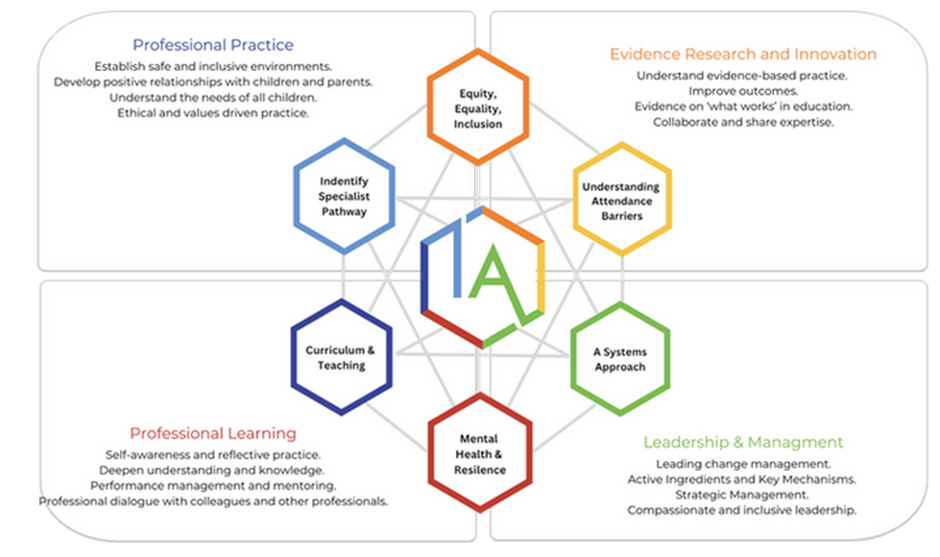
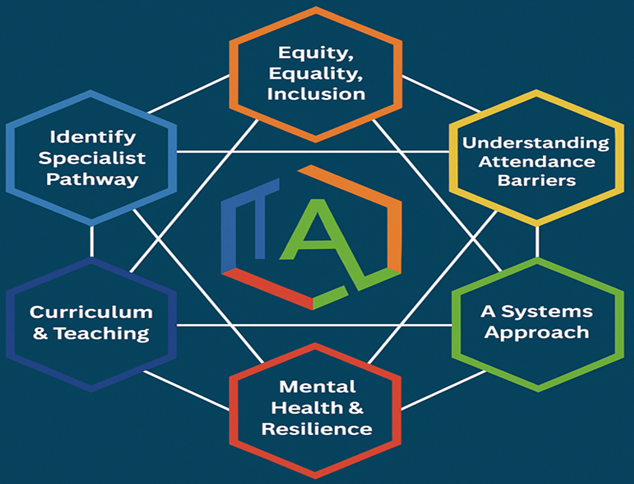
Our attendance approach is fundamentally guided by the Inclusive Attendance professional development model. Comprising six tailored Learning Modules, this model empowers us to deepen our understanding by facilitating continuous professional learning for all staff. Within this model, the four domains of practice ensure the provision of professional learning, professional development, evidence-based practices, and exemplary leadership and management to seamlessly integrate theory into practice.
Our Tiered System of Attendance Support
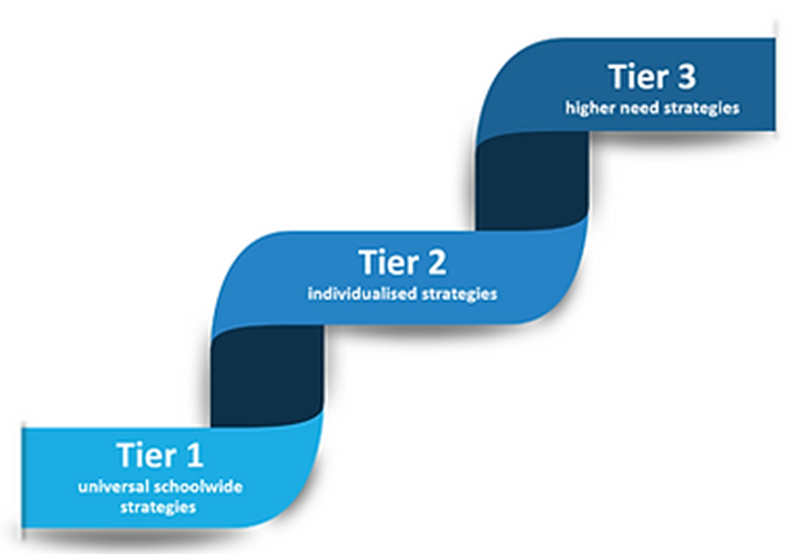
To guarantee a comprehensive approach to attendance, we implement a Multi-Tiered System of Support. A Multi-Tiered System of Support (MTSS) for school attendance involves three tiers of intervention, with roles for teachers, the school, children, parents, and external agencies – including the Local Authority. Data-driven decision-making and training requirements are pivotal to the implementation of the system. The system aligns with the Department for Education’s (DFE) “Working Together to Improve School Attendance” guidelines.
Tier 1 Universal Approach
Our school strategy for school attendance that benefits all of the children in our school.
Tier 2 Individualised Strategies
We tailor our attendance strategies at this tier to individual family and children’s needs and provide early help for persistent attendance challenges.
Tier 3 Higher Need Strategy Support
Furnishing specialised support for children, young people, and families with complex attendance requirements, including access to external agency support when necessary.
Documents – Attendance
| Attendance Policies & Documents | Download |
| Attendance Policy | Download |
What does regular school attendance mean?
Regular attendance means that your child must:
- Attend school every day unless there is an exceptional reason.
- Arrive at school on time
What should I do if my child is too unwell to attend school?
Please use the following information to make an informed decision about whether your child is too poorly to be in school.
https://www.nhs.uk/live-well/is-my-child-too-ill-for-school
- Parents must contact school on the first day of absence by 9am to let them know the reason for absence.
- If school do not hear from you, we will call you and ask why your child isn’t in school. If there is no answer, we may carry out a visit to your home to see why your child is absent.
- If your child’s attendance is below 95% additional medical evidence may be requested if your child is absent due to illness.
- School will request evidence of appointments. Without evidence, appointments may not be authorised.
New Information about Penalty Notices
On the 19th August 2024, the Department for Education (DfE) implemented new procedures which schools must follow to manage irregular attendance. As such, Headteachers can only grant leave of absence in exceptional circumstances. Therefore it is very unlikely that absence requests for a holiday will be authorised meaning any absence for a holiday or other leisure activity would be marked as unauthorised in the register. Which can lead to a fine.
The National Threshold and Penalty Notices
There is a new National Threshold for when penalty notices must be considered by all schools in England.
If a child has been absent for an unauthorised reason for 10 sessions (5 school days) during a rolling 10 week school period schools must consider a penalty notice. These sessions do not need to be consecutive.